

Artificial intelligence has crossed the threshold from a buzzword into a baseline operational requirement.
Today, almost every department—from finance to customer success—is asking for an AI budget. Yet for founders, executives, and operations leads, the first step often feels paralyzing. Generative models promise to write your marketing copy, while complex automation tools claim they can replace your entire back office overnight.
However, when organizations try to automate everything at once, they usually end up automating nothing effectively.
The real question is not whether AI can streamline a task—it is determining which process delivers the highest return with the least operational disruption. Starting with the wrong workload burns engineering hours, frustrates your team, and leaves leadership skeptical of future technology investments.
To build compounding momentum, businesses must focus their initial AI efforts where rules are clear, inputs are consistent, and failure carries minimal risk.
The AI Feasibility Framework: Predictable, Repetitive, and Contained
The most expensive mistake growing companies make when adopting artificial intelligence is targeting complex, judgment-heavy work first. Designing product roadmaps, negotiating vendor contracts, formulating commercial food recipes, or overhauling core manufacturing layouts requires human intuition, context, and nuance that algorithms cannot reliably replicate.
The ideal candidate for your first-wave AI automation must satisfy three strict criteria:
- Structured, Repetitive Inputs: The process relies on predictable datasets. Think of support ticket categories, PDF invoices, spreadsheet entries, or standard calendar inquiries.
- Defined Operational Rules: There is a clear "right" or "wrong" outcome with documented standard operating procedures (SOPs).
- Low Consequence of Error: An occasional edge-case mistake can be reviewed and corrected by a human without damaging client trust, causing financial loss, or breaching compliance standards.
"Automation is not about removing the human element from business; it is about eliminating mechanical friction so humans can concentrate on relationship-driven execution."
The 4 Best Processes to Automate First
If you are wondering exactly what a business should automate first with AI, start by looking at these four high-ROI operational bottlenecks.
1. Document Processing and Data Extraction
Every company deals with a continuous flow of messy incoming documents: vendor bills, purchase orders, compliance forms, and receipts. Modern document-intelligence tools utilize Optical Character Recognition (OCR) combined with Large Language Models (LLMs) to extract key fields automatically, eliminating manual data-entry errors and accelerating month-end closes.
2. Tier-1 Customer Support & Inbound Routing
Deploying intelligent conversational agents insulates skilled staff from repetitive friction. An AI model analyzes inbound inquiries, classifies the priority level, and routes tickets directly to the correct specialized department.
3. Internal Knowledge Retrieval
Implementing an internal AI retrieval system (Retrieval-Augmented Generation, or RAG) turns disparate documentation into an interactive knowledge engine. Team members query the system using everyday conversational language, and the tool answers with cited excerpts from approved internal handbooks.
4. Routine Content Drafting and Communications
Generative AI acts as an effective first-draft partner for meeting summarization and internal knowledge syntheses, significantly reducing the hours required to produce administrative copy while a human editor ensures the brand voice remains sharp.
Measuring the ROI of Your First AI Implementation
To justify further technology investments, track these metrics before and after implementation:
Hours Saved/Week
Manual time previously spent on tasks.
Error Reduction
Decrease in typos and misroutes.
Time-to-Resolution
How much faster a vendor gets paid.
Scaling Up: Bring in Verified Specialists
Off-the-shelf software tools can solve basic administrative bottlenecks. However, when a company looks to integrate automated AI pipelines into proprietary software architectures, scale commercial production, or execute technical corporate strategies, generic tools quickly hit their limits.
Bridging that technical gap requires specialized talent.
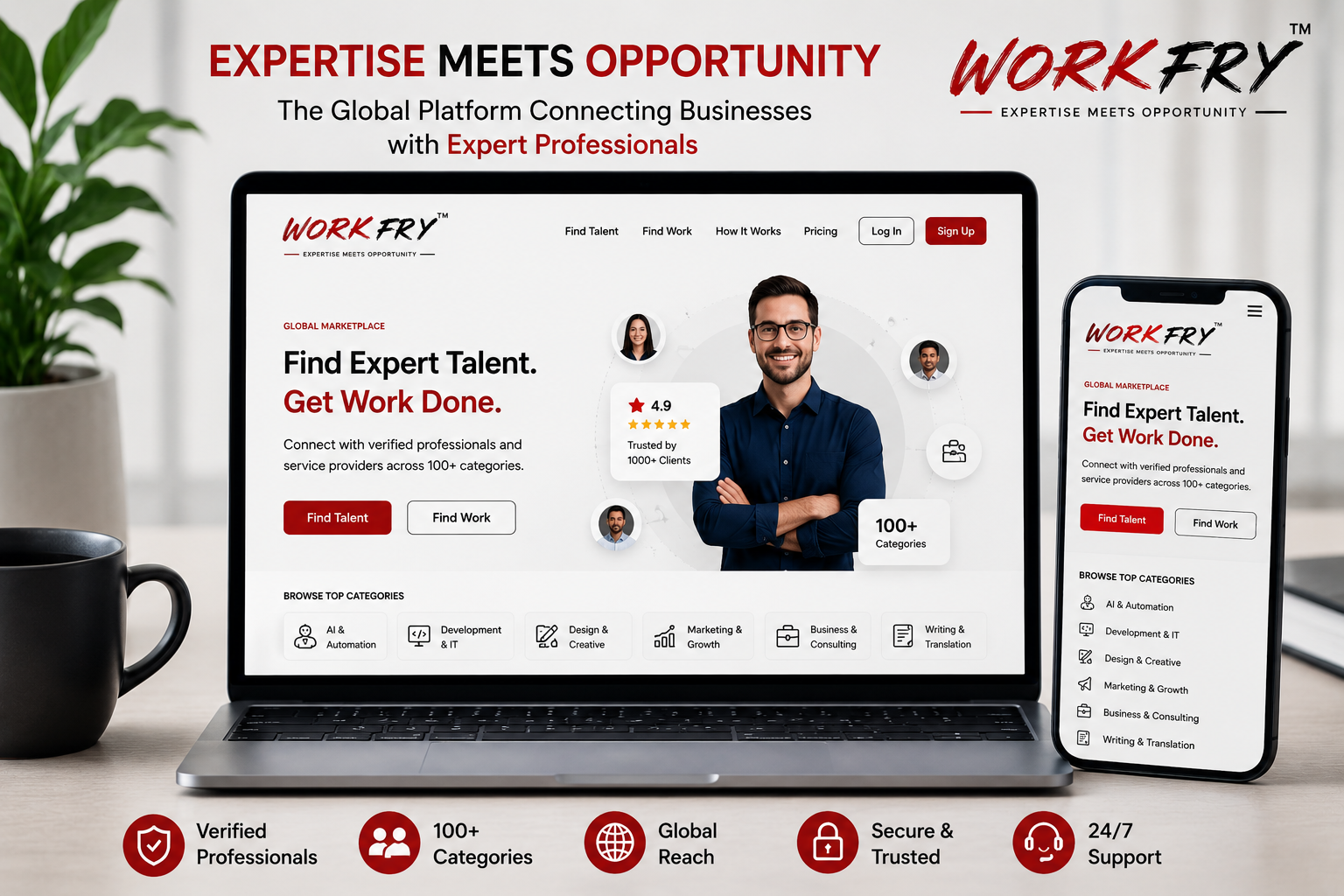
The Workfry Global Marketplace for Verified Enterprise Specialists allows enterprise leaders to scope focused technical projects—such as database performance tuning, custom API integrations, or automated cloud pipelines—with vetted domain specialists.
By structuring engagements around milestone-backed workflows, businesses maintain complete delivery control. You define the exact deliverable, fund the active milestone, review the functioning integration alongside the expert, and release payment only after the performance is verified.
SCOPE YOUR AUTOMATION BRIEF NOW →
Find your verified enterprise specialist in under 60 seconds.