
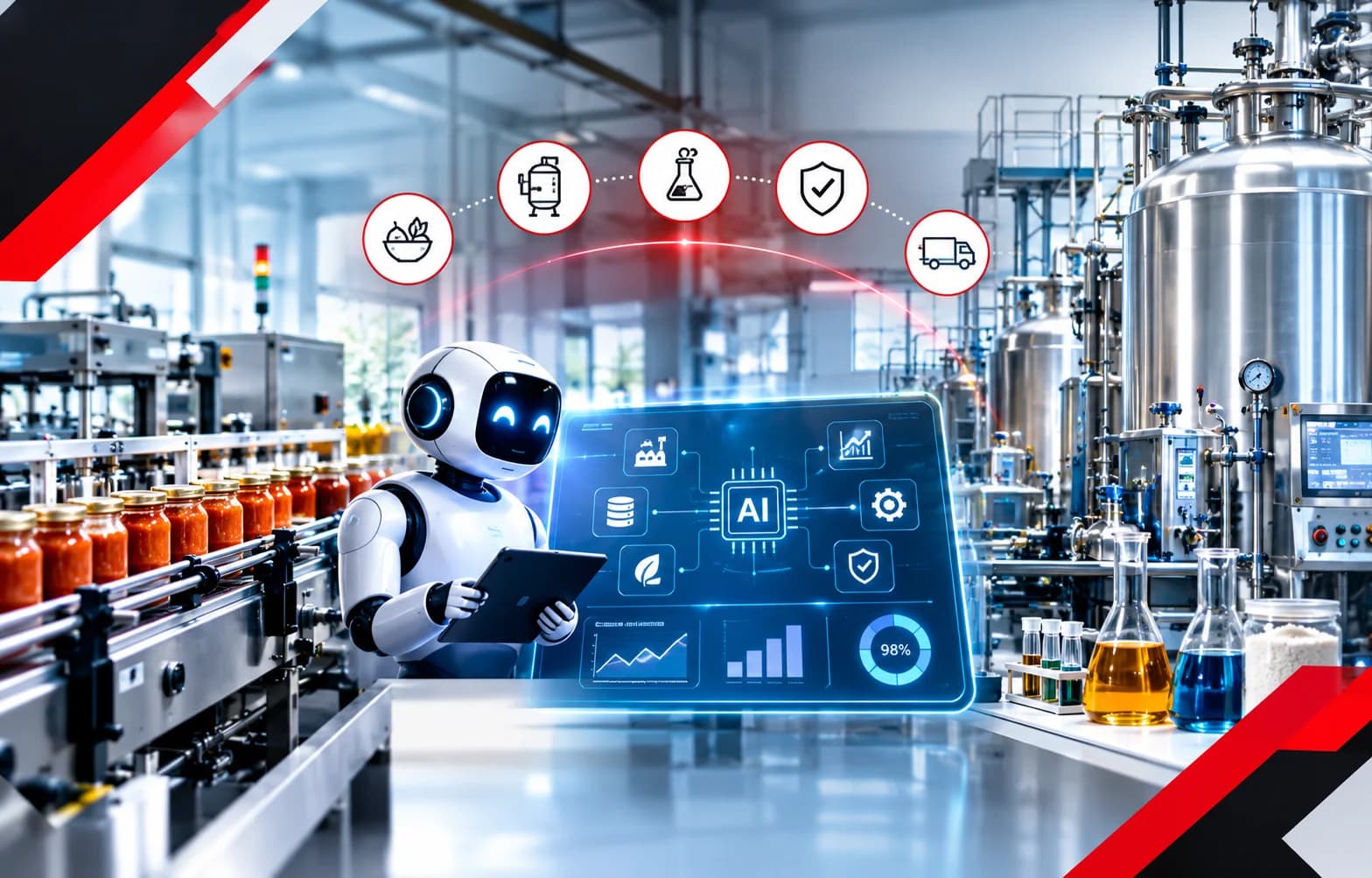
Autonomous AI agents are changing how manufacturers approach production planning, quality monitoring, maintenance, documentation, and operational decision-making. In food and chemical batch manufacturing, however, deploying AI requires more than selecting an AI tool. It requires a well-designed architecture that connects data, workflows, people, systems, and operational controls.
Key takeaway: AI agents can support complex manufacturing workflows, but their value depends on clearly defined objectives, reliable data, controlled system access, human oversight, and measurable business outcomes.
Why Autonomous AI Agents Matter in Batch Manufacturing
Batch manufacturing involves a sequence of activities that can vary according to raw materials, recipes, production schedules, equipment conditions, quality requirements, and customer specifications. Food processing and chemical manufacturing can therefore generate large amounts of operational information across production systems, laboratory records, maintenance platforms, enterprise software, and operator workflows.
Traditional automation generally follows predefined rules. Autonomous AI agents can add another layer by interpreting information, identifying patterns, recommending actions, and coordinating specific tasks across connected systems.
The objective should not be to remove human expertise. Instead, manufacturers can use AI agents to reduce repetitive work, improve information flow, support faster decisions, and help specialists focus on higher-value operational problems.
A Practical AI Agent Architecture for Manufacturing
A reliable autonomous AI system should be designed as a connected architecture rather than a standalone chatbot. A practical manufacturing architecture can contain several layers:
1. Data Layer
Connect production data, equipment information, laboratory results, inventory records, quality documentation, maintenance history, and relevant business systems.
2. Intelligence Layer
AI models interpret structured and unstructured information, identify patterns, summarize events, and generate recommendations based on defined objectives.
3. Agent Layer
Specialized agents perform defined tasks such as production monitoring, maintenance analysis, quality-document review, inventory assistance, or workflow coordination.
4. Integration Layer
APIs and controlled integrations allow agents to interact with enterprise applications, manufacturing software, databases, dashboards, and other approved systems.
5. Governance Layer
Permissions, validation rules, audit trails, human approvals, monitoring, and escalation mechanisms help keep AI-assisted workflows controlled.
High-Value Use Cases for Food and Chemical Manufacturing
AI agents should be introduced where they address a clearly defined operational problem. Potential applications include:
- Production monitoring: Track production information and identify unusual patterns that may require attention.
- Quality support: Organize quality records, identify inconsistencies, and assist teams in reviewing large volumes of documentation.
- Predictive maintenance: Analyze equipment history and operational signals to support maintenance planning.
- Inventory coordination: Help monitor material availability, consumption patterns, and replenishment workflows.
- Batch documentation: Assist with compiling, checking, and organizing production-related records.
- Operational reporting: Convert data from multiple systems into understandable summaries for plant managers and operational teams.
Manufacturers evaluating these opportunities may also benefit from specialized expertise in
AI Automation when defining the right workflow, integration approach, and implementation requirements.
Design the Workflow Before Selecting the AI Agent
One of the most common mistakes in AI implementation is starting with the technology instead of the business process. A better approach is to map the workflow first.
Business Problem → Workflow → Data → Decision → AI Agent → Human Review → Outcome
This sequence helps teams determine where an autonomous agent can provide measurable value without unnecessarily automating activities that require human judgment.
For example, instead of asking, “Where can we use AI in our plant?” a manufacturing team can ask, “Which recurring workflow consumes significant employee time, depends on multiple data sources, and has a measurable outcome?” That question provides a stronger starting point for an AI project.
Considerations for Food and Chemical Batch Operations
Although food and chemical manufacturing share several operational characteristics, each environment has its own process, quality, documentation, and risk considerations.
In food manufacturing, AI applications may focus on production consistency, ingredient planning, quality documentation, demand-related planning, equipment monitoring, and process optimization.
Chemical manufacturing can involve more complex process parameters, material characteristics, equipment conditions, and operational controls. AI systems therefore need clearly defined boundaries around what information they can interpret and what actions they are permitted to initiate.
Organizations exploring these challenges can also consider specialized
food processing consultants or
manufacturing consultants alongside AI and technology specialists.
Human Oversight Should Remain Part of the Architecture
Autonomous does not have to mean uncontrolled. In manufacturing environments, the architecture should clearly distinguish between actions an AI agent can recommend, actions it can perform automatically, and actions that require human approval.
A practical implementation can use approval thresholds, role-based permissions, exception handling, audit logs, and escalation workflows. This creates a controlled environment in which AI assists operational teams while maintaining accountability.
Important principle:
The more consequential an AI-assisted action is, the more clearly its permissions, validation requirements, and human approval points should be defined.
A Step-by-Step Deployment Approach
- Define the business outcome. Identify the measurable problem the AI agent is expected to address.
- Map the existing workflow. Document inputs, decisions, systems, people, exceptions, and outputs.
- Assess data readiness. Identify the required data sources, quality issues, access requirements, and ownership.
- Define the agent's responsibilities. Establish what the agent can observe, recommend, execute, and escalate.
- Build integrations. Connect only the systems required for the specific workflow.
- Test with controlled scenarios. Evaluate normal situations, exceptions, incorrect inputs, and edge cases.
- Measure performance. Track metrics such as processing time, error reduction, response time, productivity, and operational impact.
- Scale gradually. Expand the agent's responsibilities only after the initial workflow demonstrates reliable performance.
When Manufacturing Expertise and AI Expertise Need to Work Together
Successful AI implementation in manufacturing rarely depends on technology expertise alone. The project may require knowledge of plant operations, process engineering, quality systems, data architecture, automation, integration, and business workflows.
This is why organizations may need a combination of manufacturing specialists and AI automation professionals rather than relying on a single technical resource.
Platforms such as WorkFrycan help businesses identify and connect with professionals across different areas of expertise, including AI automation, technology, consulting, manufacturing, and specialized industry knowledge.
Conclusion
Autonomous AI agents can become a useful component of modern food and chemical batch manufacturing, but deployment should begin with the manufacturing problem rather than the AI technology.
A strong architecture connects reliable data, clearly defined workflows, specialized AI agents, controlled integrations, human oversight, and measurable outcomes. Starting with a focused use case can also make it easier to test the technology, establish operational confidence, and identify opportunities for wider deployment.
The long-term opportunity is not simply to automate individual tasks. It is to create connected workflows where people, manufacturing systems, data, and AI agents work together to improve how operational decisions are supported and executed.
Looking for Specialized Manufacturing or AI Expertise?
Define your business problem, outline the required expertise, and connect with professionals who can help evaluate, design, and implement the right solution.